“COURAGE doesn’t mean we are never scared. Courage is ACTION in the face of fear.” - Ruth Soukup

I'm just now coming to the realization of how much I've held myself back.
For so long, I've masked my own potential and hidden my own talents because of fear. The interesting thing is that I didn't even realize it was fear.
Through a combination of self-reflection, therapy, and intentional personal growth, I've been able to identify and better understand the fears that have been quietly influencing my decisions. Recently, I've been listening to Do It Scared by Ruth Soukup. In it, she explains the different fear archetypes we tend to embody, the strengths and weaknesses associated with them, and practical ways to overcome them.
What surprised me most was realizing that many of the personality traits I had accepted as simply being "who I am" were actually fear-based.
Ruth identifies seven fear archetypes:
- The Procrastinator
- The Rule Follower
- The People Pleaser
- The Outcast
- The Self-Doubter
- The Excuse Maker
- The Pessimist
I most identified with The Procrastinator, The People Pleaser, The Outcast, and The Self-Doubter. Though if we're honest, we all display each of these archetypes at certain times and in certain situations.
What's important is identifying the fear patterns that most strongly influence your life. The ones that quietly stunt your growth and limit your potential.
For example, I might feel like a Self-Doubter before a job interview or a dance performance, but I also know that I tend to perform well under pressure. Everyone can make excuses for why they didn't do something, whether it's skipping the dishes after a long day or putting off a difficult task. But at the end of the day, an excuse is still an excuse.
I've come to understand that we all exercise free will through the choices we make. You may hate your job, but you're still making the decision every day to show up to a place you resent. That realization isn't meant to judge anyone. Rather, it's a reminder that we often have more agency than we believe.
In many ways, I think modern society has shifted how control operates. While history was filled with overt forms of oppression and the removal of freedom, many of today's limitations are internal. The greatest prison for many of us isn't our environment. It's our mindset.
The fears we carry can quietly dictate our actions, our relationships, and our willingness to pursue our purpose.
Learning to identify those fears, challenge them, and actively work through them is liberating. It's what begins to free us from the invisible barriers that keep us stuck.
For me, my two most dominant fear archetypes were The People Pleaser and The Outcast.
Although I could relate to all seven in some way, these two have had the greatest impact on my life. When I reflect on my experiences, my relationships, and the conversations I've had with myself over the years, I can clearly see how these fears shaped many of my choices.
The People Pleaser
The People Pleaser's deepest fear is being judged, disappointing others, or being disliked.
People Pleasers are often highly attuned to what others think and tend to make decisions based on avoiding criticism, conflict, or rejection.
This often shows up as:
- Saying "yes" when you want to say "no"
- Overcommitting yourself
- Avoiding conflict at almost any cost
- Seeking approval before making decisions
- Feeling responsible for other people's emotions
- Struggling to prioritize your own needs
On an average day, this might look like:
- Staying late at work because you don't want to disappoint your team
- Taking on extra projects even though you're already overwhelmed
- Avoiding difficult conversations
- Constantly worrying about whether someone is upset with you
I am a recovering People Pleaser.
Take a moment and think about how much stress you've carried because of your desire to keep everyone else comfortable. Think about all the energy you've invested trying to manage other people's feelings when that same energy could have been invested in yourself and your own growth.
When I reflect on my life, it honestly frustrates me a little.
I've always been easygoing, adaptable, and willing to go along with the program. But I've started to realize how much time and energy I've poured into pleasing people and serving organizations while neglecting opportunities to build more for myself.
The reality is that there are tremendous strengths associated with this archetype. People Pleasers are often thoughtful, compassionate, generous, and empathetic.
For a long time, I convinced myself that my empathy was a weakness.
Now I remind myself that my kindness is never a weakness.
What needed to change wasn't my kindness. What needed to change was my ability to protect it.
That meant establishing boundaries, accepting that not everyone will approve of me, understanding that disappointment is not the same as rejection, and making decisions that honor me, not just everyone around me.
The Outcast
The Outcast's deepest fear is rejection and vulnerability.
To protect themselves, they often pull away before someone else can pull away from them. They reject opportunities, relationships, or connections before those things have the chance to reject them.
Outcasts often:
- Have difficulty trusting others
- Prefer independence
- Keep emotional walls up
- Resist depending on others
- Appear tough or unaffected
- Avoid situations where they might feel vulnerable
The Outcast has many strengths.
We're independent, resilient, self-reliant, internally motivated, willing to take risks, and often remarkably capable of recovering from setbacks.
But those same strengths can become limitations when taken too far.
We struggle to trust people. We hesitate to ask for help. We keep our emotional walls high and avoid situations that require vulnerability. We expect rejection, so we don't reach out. We turn opportunities into solo missions and make them harder than they need to be.
And in doing so, we miss opportunities for connection, support, and community.
Of all the fear archetypes, The Outcast spoke to me the most.
When I look back on my life, I can see moments where I walked away from friendships, relationships, and opportunities because I viewed myself as an outsider.
I remember attending the University of Cincinnati and feeling like an outcast in my engineering classes. I was a poor inner-city girl from Dayton sitting among students who seemed more privileged and established than I was.
I didn't feel like I belonged.
So, I isolated myself.
What I should have realized is that although I looked different from many of the people around me, I had earned my seat in that classroom just like they had. I worked hard to get there. In some cases, I may have worked even harder.
But I allowed intimidation, insecurity, and fear-based thinking to influence my path.
To be clear, I don't view my choices as failures. I eventually switched my major to Biology and have built a successful and fulfilling career.
That's not the point.
The point is realizing how often fear influenced my decisions.
Even when things worked out, many of my choices were still being made from a fight-or-flight mindset. More often than not, I chose flight.
I chose retreat.
I chose distance.
I chose safety over possibility.
But change begins with awareness.
Awareness requires sitting with yourself long enough to understand who you are today and who you want to become.
As I've continued that process, I've realized just how much my Outcast archetype has held me back, especially when it comes to business ventures and larger goals that require networking, collaboration, and trust.
Now I understand that it isn't my capability that's limiting me.
It's my fear.
And fear, when left unchecked, becomes an excuse not to take action.
That fear didn't develop for no reason. Our childhoods, experiences, disappointments, and wounds all help shape who we become.
But understanding where a fear comes from doesn't mean I have to continue living under its influence.
Now that I can clearly identify it, I can challenge it.
And that changes everything.
Every day, I'm learning more about myself.
I'm learning that yes, I am an introvert. I enjoy solitude. I value quiet. Socializing can drain my battery.
But I'm also realizing that I can't hide behind that label when it comes to sharing my gifts with the world.
What I can do is intentionally push beyond my comfort zone, take action despite my fears, and then give myself the space to retreat, recharge, and recalibrate when needed.
That balance allows me to continue growing without burning out.
For the first time, I'm beginning to understand that the thing holding me back wasn't a lack of talent, opportunity, intelligence, or potential.
It was fear.
And now that I can see it, I can finally start moving beyond it.
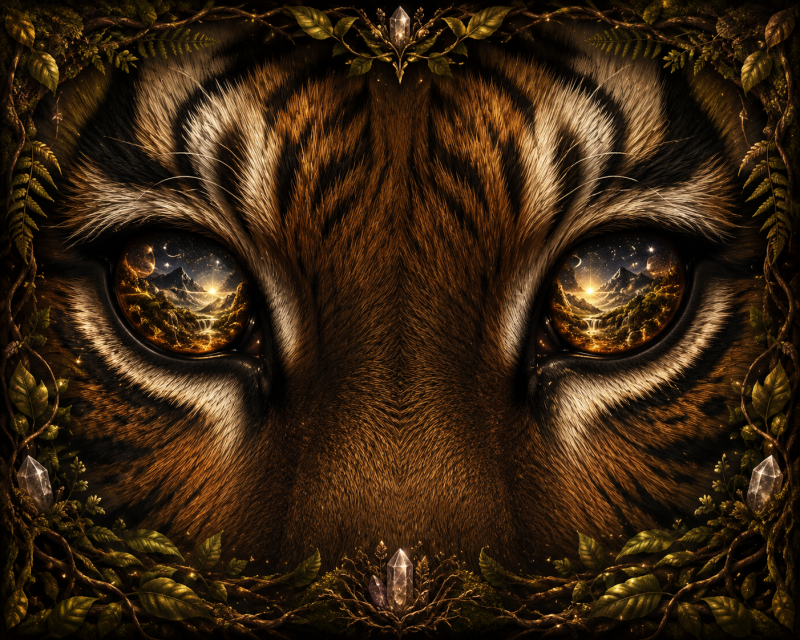
Two nights ago, I had a dream that I opened my front door and saw a tiger standing at the edge of my driveway, staring directly at me.
What stood out most wasn't the tiger itself. It was my reaction.
I wasn't afraid.
I was captivated.
I stood there staring at the tiger as the tiger stared back at me.
Spiritually, tigers are often associated with:
- Personal power and confidence
- Instinct and intuition
- Courage
- Independence
- A powerful force that cannot be easily controlled
- A presence that commands respect
- Hidden strength rising to the surface
As I reflected on the dream, I realized the tiger represented the potential that lies ahead of me as I continue to overcome my fears.
The tiger symbolized a personal power that is awakening within me. A power that grows stronger as I reconnect with the wild, untamed, and authentic parts of myself that I've spent years suppressing.
The truth is, I've always had a complicated relationship with power.
For much of my life, I associated power with corruption and destruction. We see those stories everywhere. In movies, television, history books, and even everyday life, we're constantly shown examples of what happens when power goes unchecked. We see greed. We see manipulation. We see ego. We see people using power to dominate rather than uplift.
Because of that, I think I've unconsciously held myself back from stepping fully into my own power and purpose.
But as I reflected on that dream, I found myself asking a different question.
What about power that is paired with consciousness?
What about power that is guided by self-awareness?
What about power that is rooted in service, integrity, and love rather than control?
The eyes of the tiger seemed to challenge the beliefs I had carried for years.
Maybe power itself isn't the problem.
Maybe the real issue is power without wisdom.
And perhaps my fear of becoming corrupted by power has, in some ways, prevented me from embracing the strength that was always meant for me.
The tiger wasn't threatening me.
It was introducing itself.
It was reminding me of something that has always existed within me.
And for the first time, I feel ready to explore what that means.
It's time for me to find out.
Add comment
Comments